

Through his work with Tsq̓éscen̓ First Nation (Canim Lake Band) and with over 45 years of experience as a rural family physician, Dr Bruce Nicolson has seen firsthand the positive impact of relationship-building between physicians and Indigenous patients.
Early in his career, Dr Nicolson provided weekly visits to the White Feather Clinic in Canim Lake. He now serves as a project lead for Facility Engagement through the Specialist Services Committee (SSC), helping both new and experienced physicians advance their journey toward providing culturally safe care.
“I thought, if we can design a program and bring these physicians to the Tsq̓éscen̓ First Nation to meet with the community, to learn about their holistic approach to medicine and spiritual care, then this is going to improve the doctor-patient relationship and, subsequently, health care outcomes,” explains Dr Nicolson, who is based in 100-Mile House.
In recent years, many small, rural communities such as 100-Mile House have become increasingly dependent on the Practice-Ready Assessment (PRA) program which helps to accelerate the licensing process for experienced, international medical graduates (IMGs) to join the Canadian health care system.
While these programs strengthen the provision of medical care in the community, they can present unique cultural barriers.
Many physicians who arrive in British Columbia must navigate their own cultural transitions as they settle into their new environment. Some may even have had similar experiences with colonialism and the loss of their culture in their home country. Dr Nicolson observes that these doctors openly acknowledge the challenges they face in understanding and connecting with Indigenous patients, recognizing that their previous exposure to Indigenous culture has often been limited or shaped by second-hand stories.
Their willingness to learn and adapt reflects both humility and a genuine desire to provide thoughtful, respectful care to all members of the community.
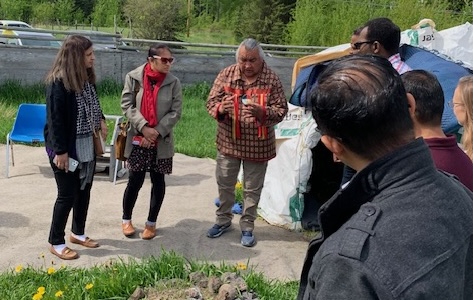
In partnership with the Canim Lake Band Council, Dr Nicolson arranged two engagement sessions for physicians from 100-Mile House to spend a day in Canim Lake learning about Indigenous culture, traditional healing, and getting to know the community. The project is funded through the Facility Engagement Initiative, a BC-wide program of the Specialist Services Committee (SSC), one of four Joint Collaborative Committees (JCC) of Doctors of BC and the Government of BC.
Although the project is still in its early stages, it has had a big impact.
Attendees have reported feeling more comfortable providing culturally safe care, noting that they are able to build a great rapport with patients presenting to the ER. They have also participated in smudging ceremonies, held at 100 Mile District General Hospital.
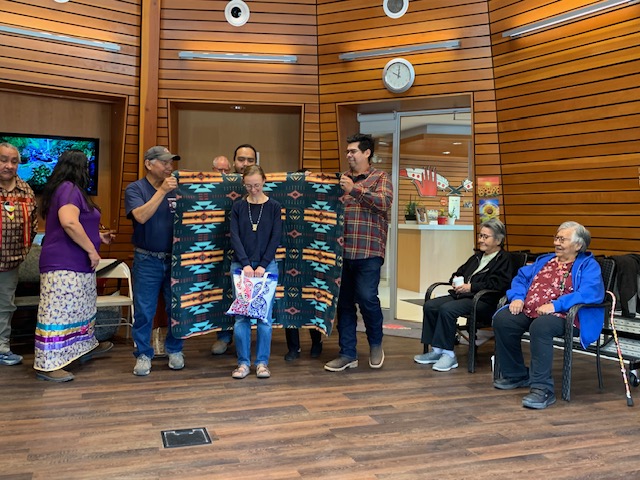
Dr Adrienne Montgomery, a family physician also based in 100-Mile House, has provided weekly visits to the White Feather Clinic since 2017. Over the last nine years, she has witnessed the strengthening of the physician-patient relationship and has continued to build upon that impact. At the most recent learning session in the spring of 2025, Dr Montgomery was honoured in a blanket ceremony. Dr Nicolson reflected that during the ceremony, “All the doctors in attendance felt honoured, right along with Dr Montgomery.”
The project team aims to build on these successes and share them with other rural communities, continuing to pave the way for this type of relationship-building.
To help spread the word about the Canim Lake Project, Dr Nicolson has presented at a Facility Engagement Interior Showcase Conference. Alongside project manager Anna Meyers, they have also presented at a Facility Engagement “Quick Wins” workshop.
Recently, Dr Nicolson has also attended a JCCs Community-Based Experiential Learning Session, organized by the Indigenous Specific Anti-Racism & Cultural Safety team at Doctors of BC, using those opportunities to connect with like-minded colleagues and share more about his own experiences.
Through this work, he hopes to inspire his peers to begin the conversation in the regions they serve.
“If you are in a rural community with any sort of Indigenous population and you haven’t done something like this yet, you need to start. You just have to ask.”
Learn more about supporting Indigenous patients and communities on the Doctors of BC Truth and Reconciliation page where you will find information about upcoming learning sessions, the Guides to Respectful Indigenous Engagement and Territorial Acknowledgements, and how we are advancing and actioning reconciliation as an organization.